Efficient AI
Pruning / Sparsity (II)
Aditya Desai
Many thanks to all the resources listed in References on the main website. Almost all figures are taken from these resources; some were generated with Gemini. Some images are taken from Google Images and still need proper citation (in progress).
Logistics : Audit
- Currently 8 Students are enrolled for auditing the class
- Audit Students are expected to attend all classes (slack = 3 classes).
- Sign in sheet from next class (TA)
Logistics: Seminar
- Seminar starts on 21st August 2026
- Seminar will happen on every Friday.
- Groups will be created by TAs. We will announce the groups in the next class.
- First Seminar is on Sparse Attention(Decoding)
Logistics: Exams
- Exams are more of a tool to encourage engagement
- Seminar is part of the syllabus. Projects are part as well.
- If you are attending classes and following them, you should be good for exams
Logistics: Project
- Hope you have started working on your projects!
- Submission portal opens next week and first leaderboard will be released a week after that.
- Assignment 1: Get on the leaderboard : Make a submission (no memory constraint)
- Grade: 1% of the entire grade (taken from project )
- Deadline: 14th August 2026
Logistics: Project Evaluation
- Compression of Interest: $10\%, 20\%$ and $40\%$ of BF16 checkpoints
- if a Submission has memory $k\%$ it goes in all heads that are larger than $k$
Hessian complexity
AutoML
How much to prune in each layer? Unstructured Pruning
-
Natural alternatives,
- OBS, OBD : iterative pruning already chooses weights dynamically. Generally impractical for big networks.
- IMP: We can do global pruning by choosing weights across all layers. This can lead to degenerate pruning.
- Do pruning layer-wise
- How to distribute the target sparsity across layers?
AutoML for Pruning
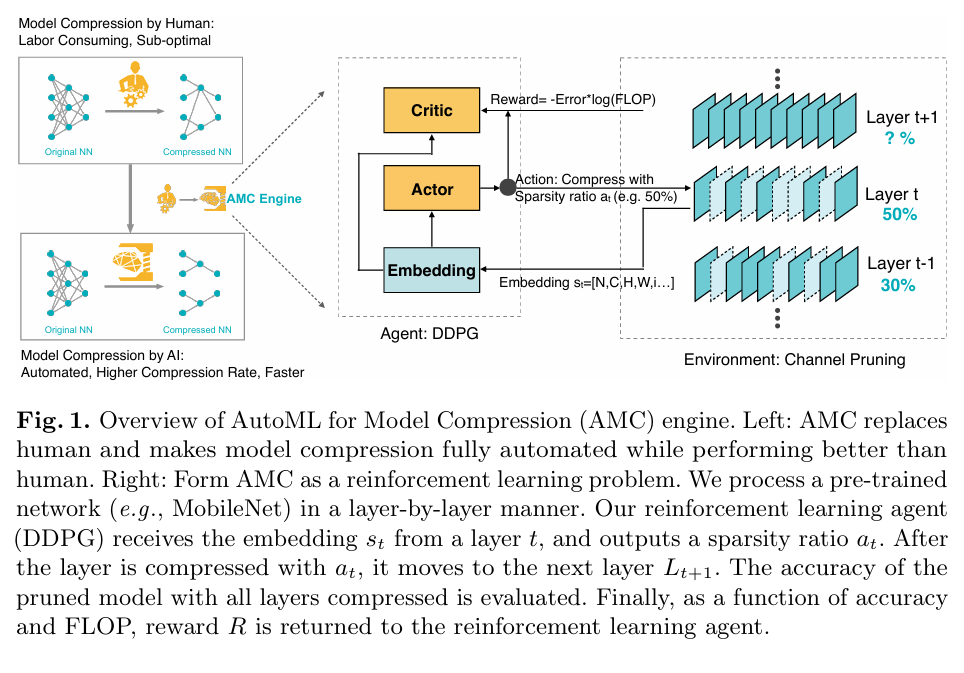
use RL to learn sparsity predictors for each layer
Structured Sparsity
Unstructured Sparsity vs. Structured Sparsity
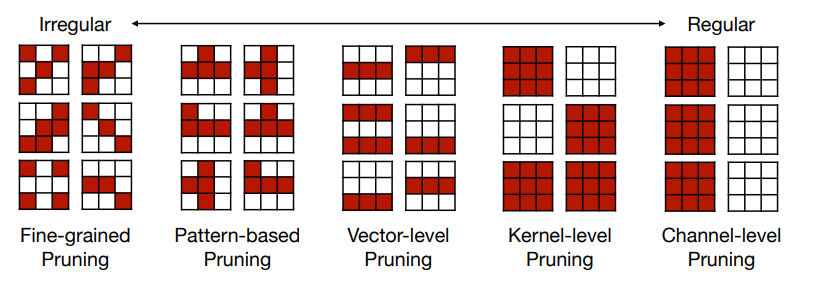
- Quality?
- Efficiency?
Quality

- # possible patterns ( # subspaces for projection)
- # Possiblity of finding a nearby projection
Efficiency?
Unstructured sparsity:
- does not have contiguous memory access (overheads). i.e. low computational intensity
- cannot use tensor cores.
- 50% sparsity needs n/2 floats + index memory (n/2 log(n) bits)
Making Unstructured Sparsity Efficient?
Some work tries to make unstructured sparsity efficient:
When do we see a breakthrough for speed?
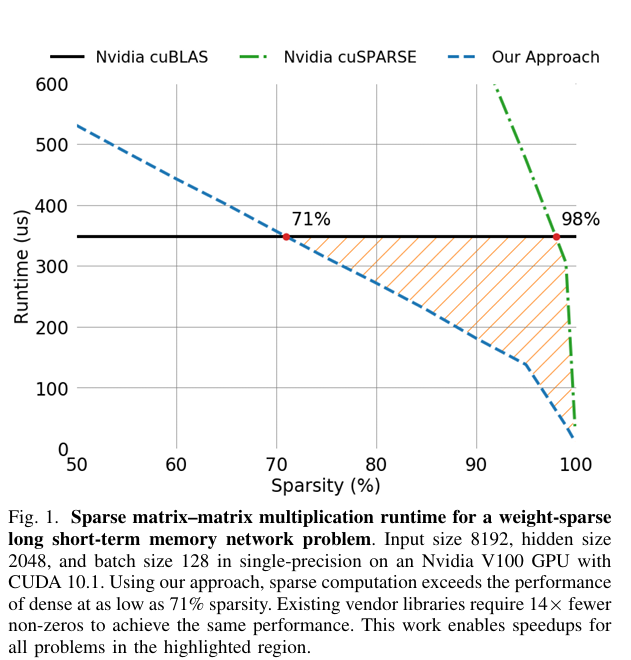
- One example from : Sparse GPU Kernels for Deep Learning Gale.et.al
- Getting speedups is HARD
- As GPU hardware improves, dense GEMMs are super optimized for. Gets even difficult.
Promise of Structured Sparsity
- Reduce the "shape" of the workload
- reuse existing optimized dense kernels
- Challenge: Maintaining Quality
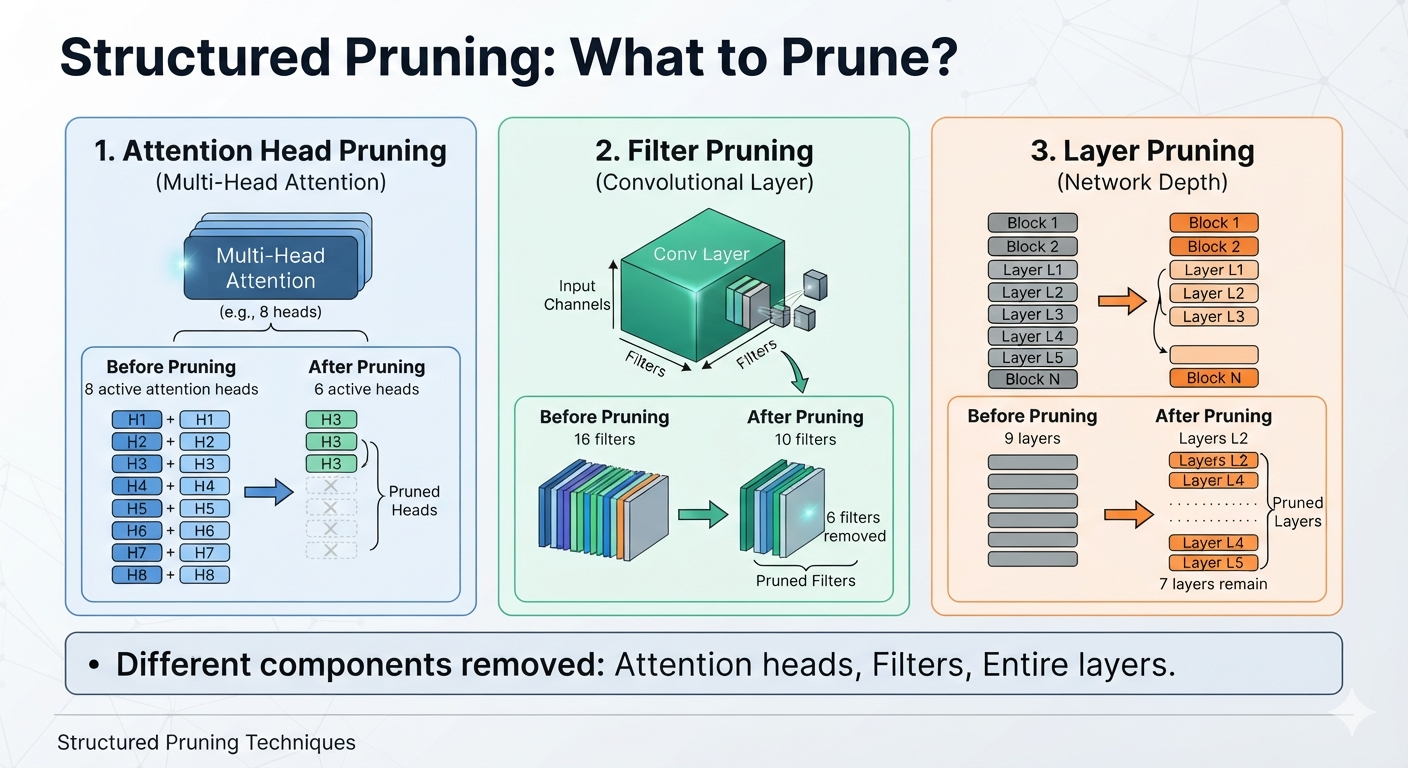
Pruning a Linear layer -- a hardware friendly way
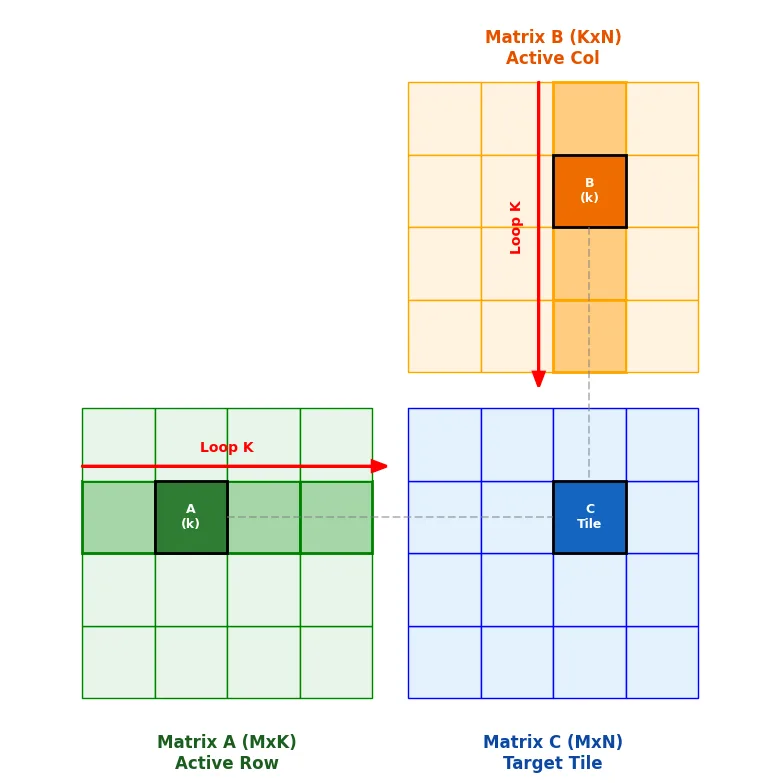
- What is the algorithm for MM (matrix multiplication) on GPU?
- Why is tiling important?
- How would you prune?
Pruning a Linear layer : a hardware friendly way
- Look at the algorithm where weight is used and make sure that the sparsity does not break contiguous memory access or add any overheads FLOPS reduction should lead to actual reduction of steps in existing kernels.
Pruning a Linear layer : a hardware friendly way
- Neuron / Channel pruning: Remove columns/rows to reduce the shape of the workload
- Block Sparsity: Ability to skip certain "blocks" in computing the matrix multiplication — block-wise sparsity
Pruning a convolution : a hardware friendly way
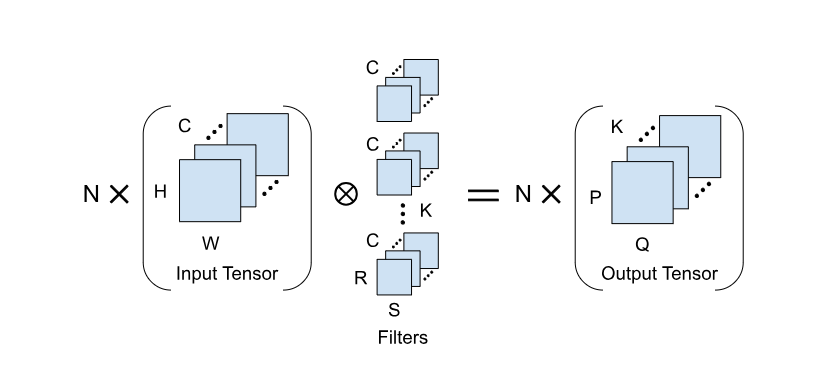
Pruning a convolution : a hardware friendly way
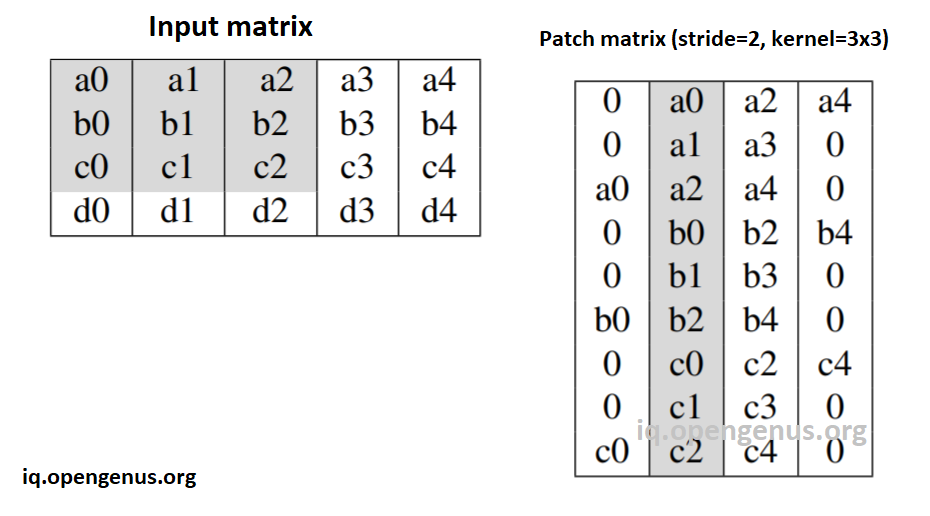
- Im2col and GEMM implementation of convolution (#channels = 1)
Pruning a convolution : a hardware friendly way
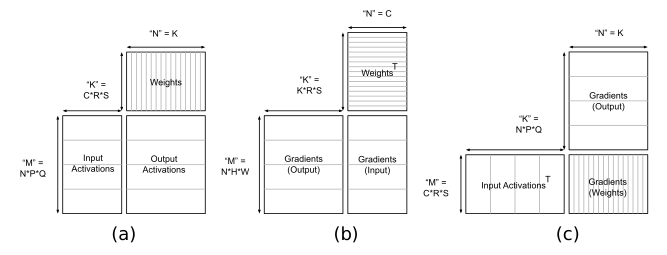
How to prune? (General Recipe for Groups)
- Train a dense network to convergence.
- Compute the saliency score of each group of weights
- Remove group with the smallest saliency scores (or multiple, with / without adjustment of others)
- Retrain the pruned network. Return to step 2 (iterate until target sparsity).
How to prune?
- Extend OBS (sim. OBD) to get saliency and update rule for groups of weights? (Exercise)
- Iterative Magnitude Pruning (IMP) can be extended to groups of weights through l_p norms
-
The $\ell_p$ norm of a weight vector $w$ is defined as:
$\displaystyle \| w \|_p = \left( \sum_{i=1}^{n} |w_i|^p \right)^{1/p}$ - While training, you can use group wise $l_p$ regularizer to induce group sparsity.
Results from the paper
“Learning Structured Sparsity in Deep Neural Networks” by Wen et al.
Unstructured sparsity does not show speedups on CPUs / GPUs
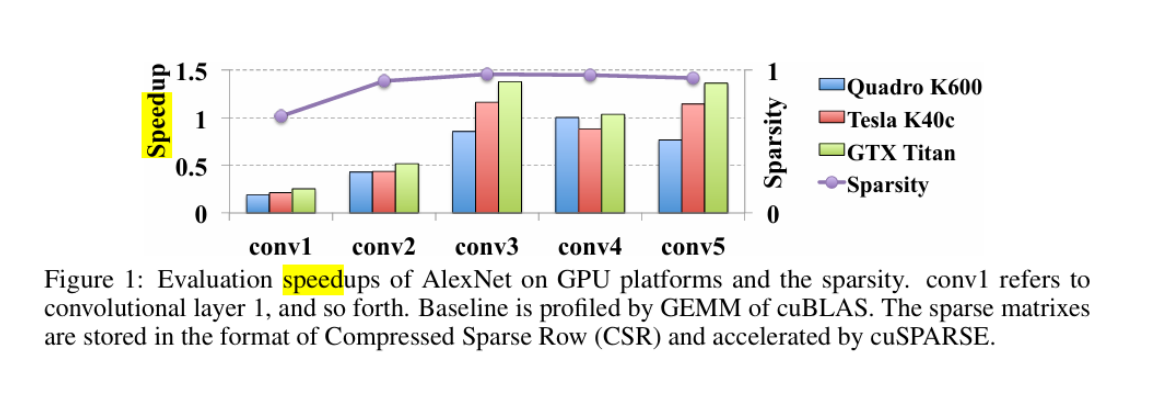
Even at high sparsity, irregular sparse execution can be slower than dense GEMM because storage and indexing overheads dominate.
Structured pruning for CNNs
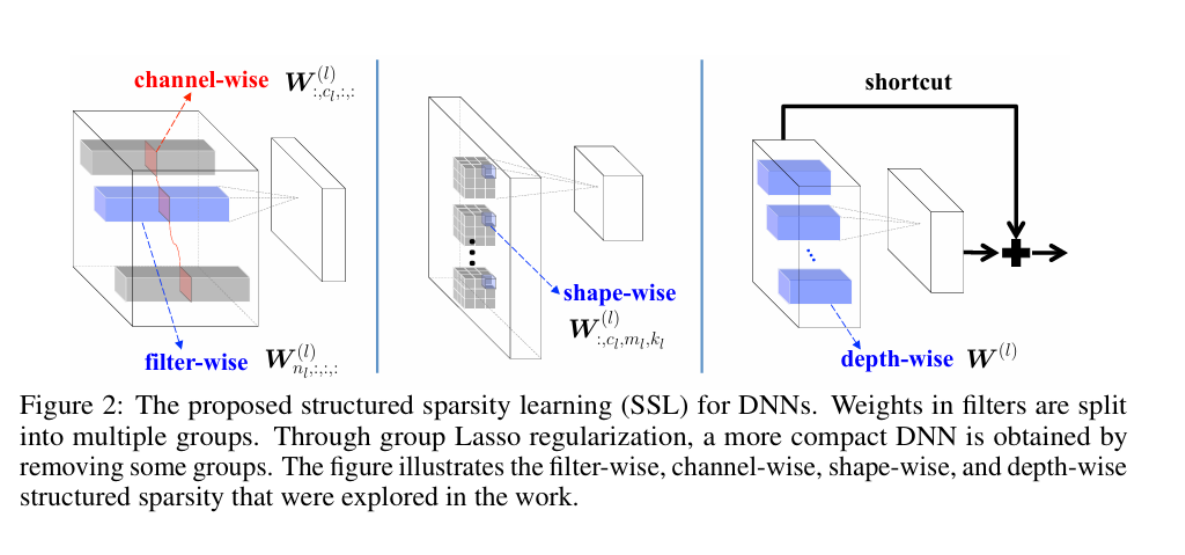 (Exercise) In GEMM Implementation how do these pruning granularities reduce workload?
Experimental setup
-
Three-step scheme:
- Train with group regularization.
- Prune groups with the lowest magnitude.
- Fine-tune the remaining network.
- Reported speedups are layer-wise and measured on CPU unless specified.
LeNet: filters, channels, and filter shapes
| LeNet # | Error | Filter # | Channel # | FLOP | Speedup |
|---|---|---|---|---|---|
| 1 (baseline) | 0.9% | 20–50 | 1–20 | 100%–100% | 1.00×–1.00× |
| 2 | 0.8% | 5–19 | 1–4 | 25%–7.6% | 1.64×–5.23× |
| 3 | 1.0% | 3–12 | 1–3 | 15%–3.6% | 1.99×–7.44× |
| LeNet # | Error | Filter size | Channel # | FLOP | Speedup |
|---|---|---|---|---|---|
| 1 (baseline) | 0.9% | 25–500 | 1–20 | 100%–100% | 1.00×–1.00× |
| 4 | 0.8% | 21–41 | 1–2 | 8.4%–8.2% | 2.33×–6.93× |
| 5 | 1.0% | 7–14 | 1–1 | 1.4%–2.8% | 5.19×–10.82× |
Structured groups preserve LeNet accuracy while reducing layer FLOPs substantially and reaching up to 10.82× measured speedup.
MLP and ConvNet structured sparsity
| MLP # | Error | Neurons per layer | FLOP per layer |
|---|---|---|---|
| 1 (baseline) | 1.43% | 784–500–300–10 | 100%–100%–100% |
| 2 | 1.34% | 469–294–166–10 | 35.18%–32.54%–55.33% |
| 3 | 1.53% | 434–174–78–10 | 19.26%–9.05%–26.00% |
| ConvNet # | Error | Row sparsity | Column sparsity | Speedup |
|---|---|---|---|---|
| 1 (baseline) | 17.9% | 12.5%–0%–0% | 0%–0%–0% | 1.00×–1.00×–1.00× |
| 2 | 17.9% | 50.0%–28.1%–1.6% | 0%–59.3%–35.1% | 1.43×–3.05×–1.57× |
| 3 | 16.9% | 31.3%–0%–1.6% | 0%–42.8%–9.8% | 1.25×–2.01×–1.18× |
Learned structure cuts MLP FLOPs and accelerates ConvNet layers without degrading—and sometimes improving—test error.
AlexNet on ILSVRC 2012
| # | Method | Top-1 err. | Statistic | conv1 | conv2 | conv3 | conv4 | conv5 |
|---|---|---|---|---|---|---|---|---|
| 1 | ℓ₁ | 44.67% | sparsity | 67.6% | 92.4% | 97.2% | 96.6% | 94.3% |
| CPU × | 0.80 | 2.91 | 4.84 | 3.83 | 2.76 | |||
| GPU × | 0.25 | 0.52 | 1.38 | 1.04 | 1.36 | |||
| 2 | SSL | 44.66% | column sparsity | 0.0% | 63.2% | 76.9% | 84.7% | 80.7% |
| row sparsity | 9.4% | 12.9% | 40.6% | 46.9% | 0.0% | |||
| CPU × | 1.05 | 3.37 | 6.27 | 9.73 | 4.93 | |||
| GPU × | 1.00 | 2.37 | 4.94 | 4.03 | 3.05 | |||
| 3 | pruning [7] | 42.80% | sparsity | 16.0% | 62.0% | 65.0% | 63.0% | 63.0% |
| 4 | ℓ₁ | 42.51% | sparsity | 14.7% | 76.2% | 85.3% | 81.5% | 76.3% |
| CPU × | 0.34 | 0.99 | 1.30 | 1.10 | 0.93 | |||
| GPU × | 0.08 | 0.17 | 0.42 | 0.30 | 0.32 | |||
| 5 | SSL | 42.53% | column sparsity | 0.00% | 20.9% | 39.7% | 39.7% | 24.6% |
| CPU × | 1.00 | 1.27 | 1.64 | 1.68 | 1.32 | |||
| GPU × | 1.00 | 1.25 | 1.63 | 1.72 | 1.36 |