Efficient AI
Tail Bounds(White Board) & GPU Programming Model
Aditya Desai · August 12th 2026
Many thanks to all the resources listed in References on the main website. Almost all figures are taken from these resources; some were generated with Gemini. Some images are taken from Google Images and still need proper citation (in progress).
Example Workload: $C = A + B$
Problem. Given two matrices $A, B \in \mathbb{R}^{m \times n}$, compute $C \in \mathbb{R}^{m \times n}$ by element-wise addition and store the result:
$$C_{ij} = A_{ij} + B_{ij} \quad \text{for all } i \in [m],\; j \in [n]$$
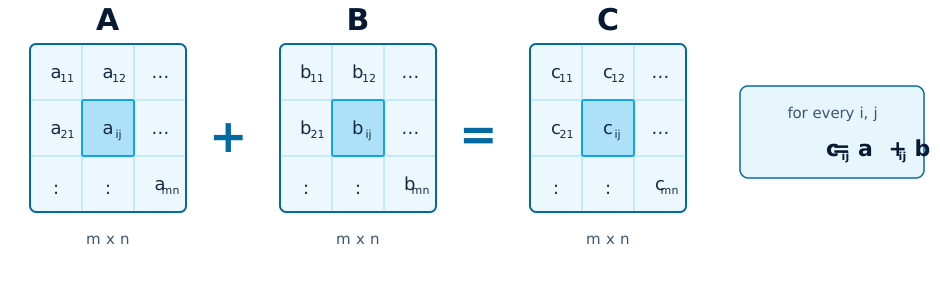
Example Workload: $C = A + B$
Traditional C (row-major, nested loops):
void mat_add(const float *A, const float *B, float *C,
             int m, int n) {
  for (int i = 0; i < m; i++) {
    for (int j = 0; j < n; j++) {
      int idx = i * n + j;
      C[idx] = A[idx] + B[idx];
    }
  }
}- One thread of control; $mn$ additions in sequence
- Entry $(i,j)$ lives at offset $i\cdot n + j$
Example Workload: $C = A + B$
- Massive parallelization opportunity: $mn$ additions can be done in parallel.
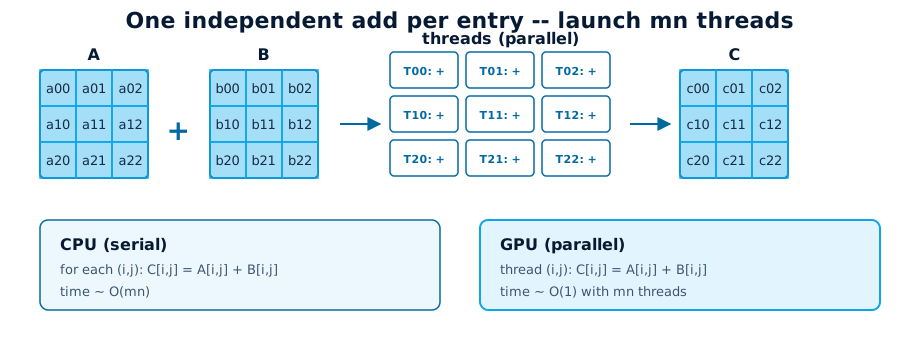
OpenMP Code for $C = A + B$
Shared-memory parallelism via OpenMP pragmas:
#include <omp.h>

void mat_add(const float *A, const float *B, float *C,
             int m, int n) {
  #pragma omp parallel for collapse(2)
  for (int i = 0; i < m; i++) {
    for (int j = 0; j < n; j++) {
      int idx = i * n + j;
      C[idx] = A[idx] + B[idx];
    }
  }
}
#pragma omp parallel for— split loop iterations across threadscollapse(2)— flatten the nested loops into one $mn$-iteration space
CPU vs. GPU architecture choice
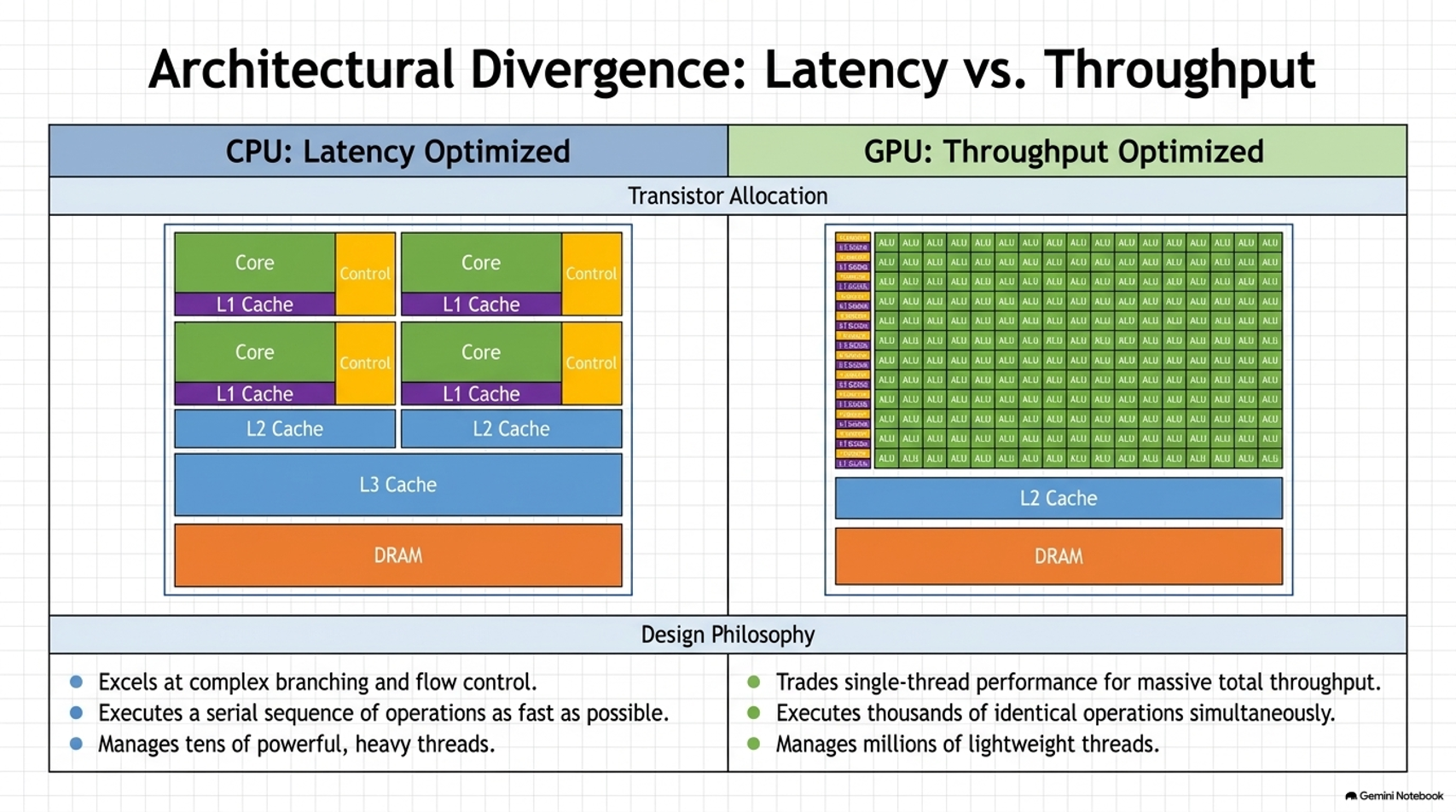
GPU Code for $C = A + B$
CUDA C: one thread per entry
__global__ void mat_add(const float *A, const float *B,
                        float *C, int m, int n) {
  int i = blockIdx.y * blockDim.y + threadIdx.y;
  int j = blockIdx.x * blockDim.x + threadIdx.x;
  if (i < m && j < n) {
    int idx = i * n + j;
    C[idx] = A[idx] + B[idx];
  }
}

// launch in main:
main() {
  ....
  dim3 block(16, 16);
  dim3 grid((n + 15) / 16, (m + 15) / 16);
  mat_add<<<grid, block>>>(A_d, B_d, C_d, m, n);
  ....
}- Kernel: each thread computes one $C_{ij}$
- Launch: 2D grid of $16\times 16$ thread blocks covering $m\times n$
- Grid of blocks and block of threads — a way of organizing threads.
- Defines how threads are mapped to hardware.
- And thus how they are allowed to interact.
GPU systems
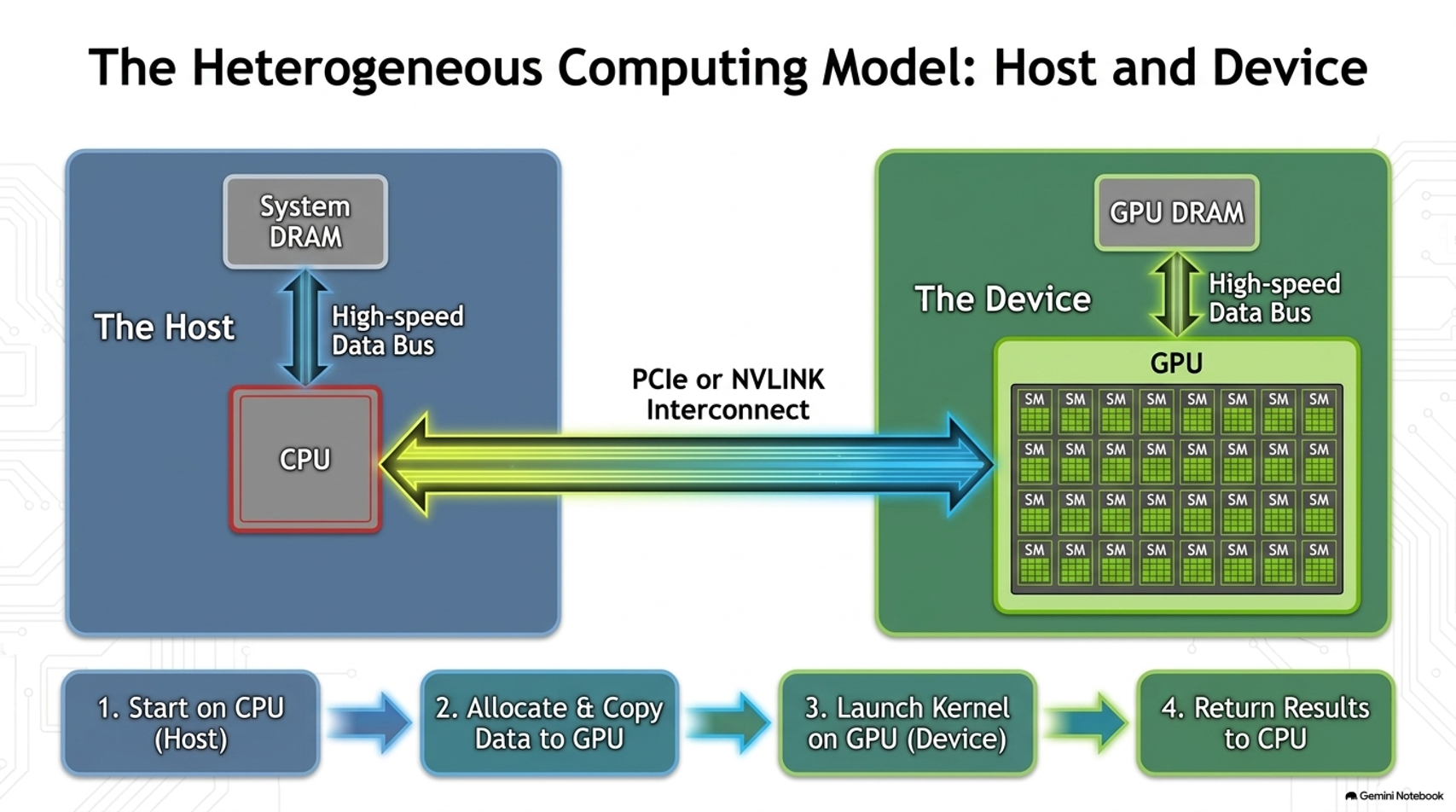
Streaming Multiprocessors
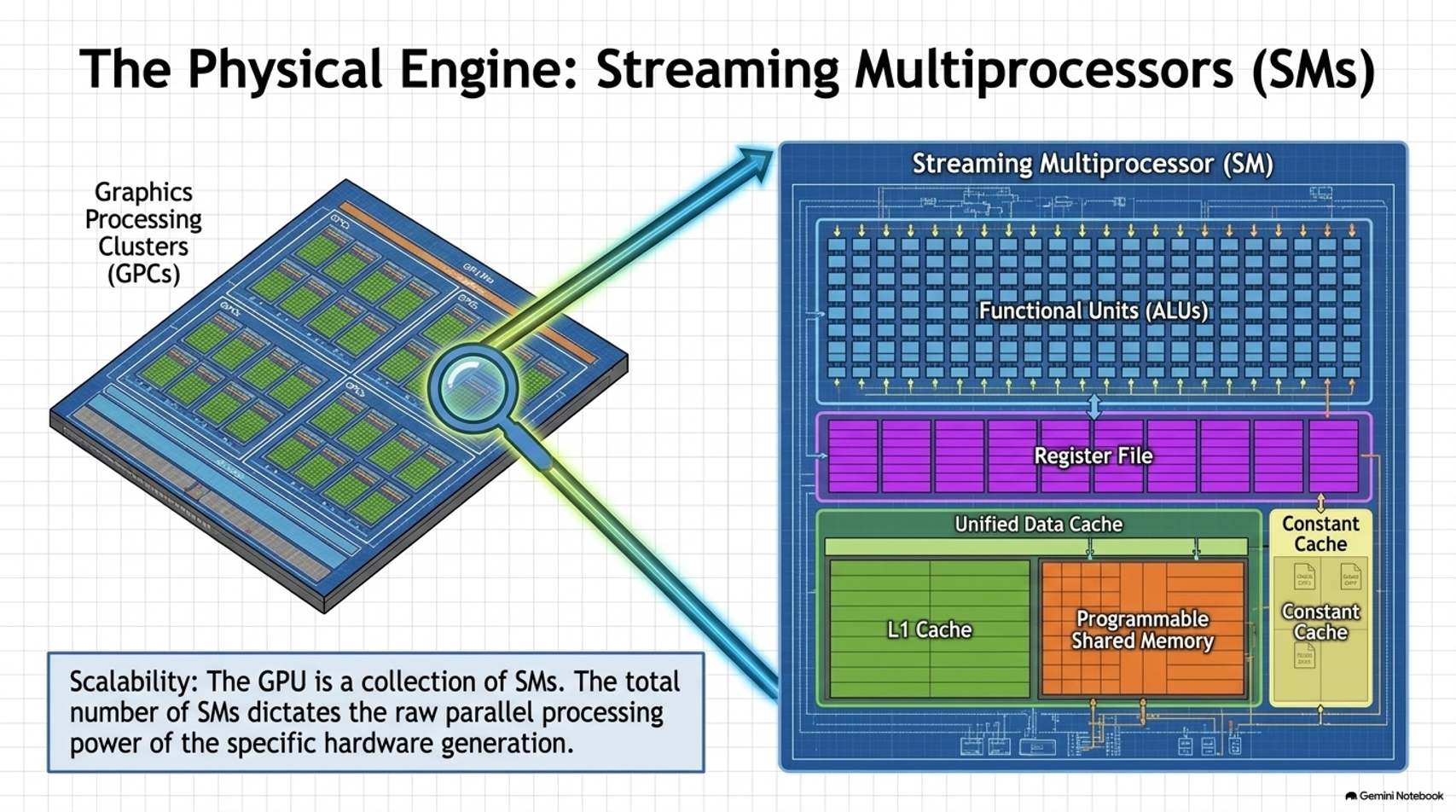
Block / Thread mapping to hardware
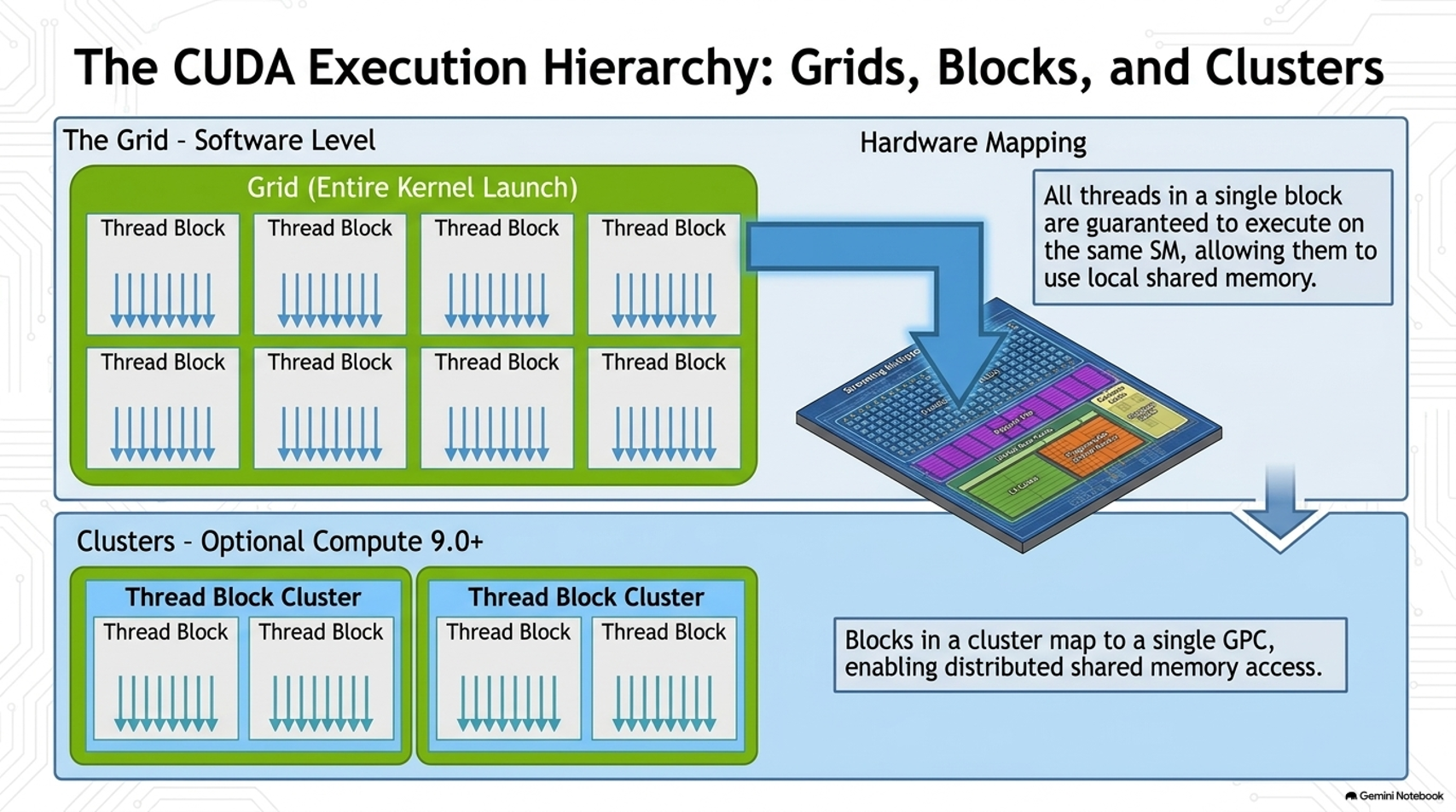
- All threads in a block are executed on a single SM.
- These threads can sync among each other and use shared memory for information sharing.
- Threads across blocks cannot sync.
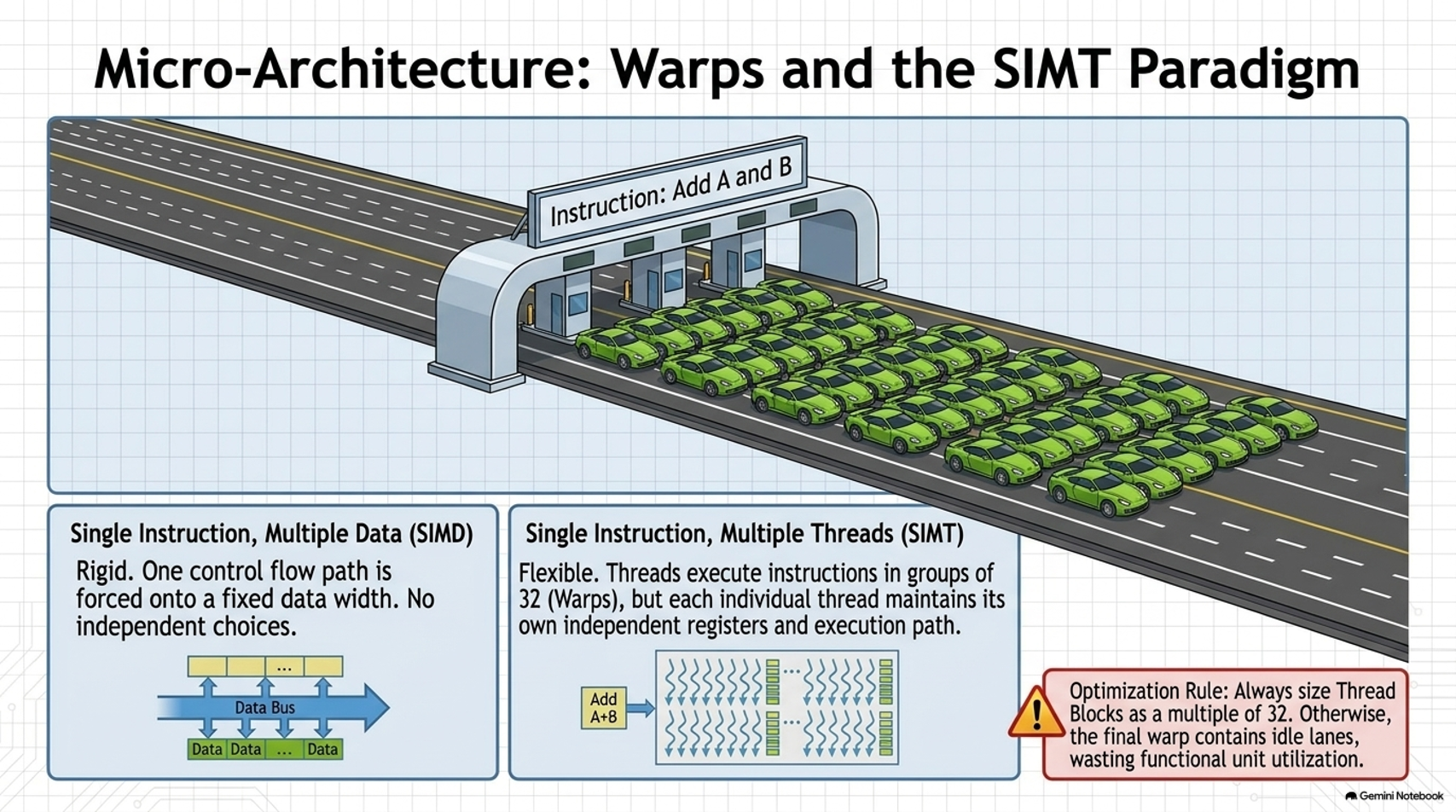
Warp: unit of computing and scheduling
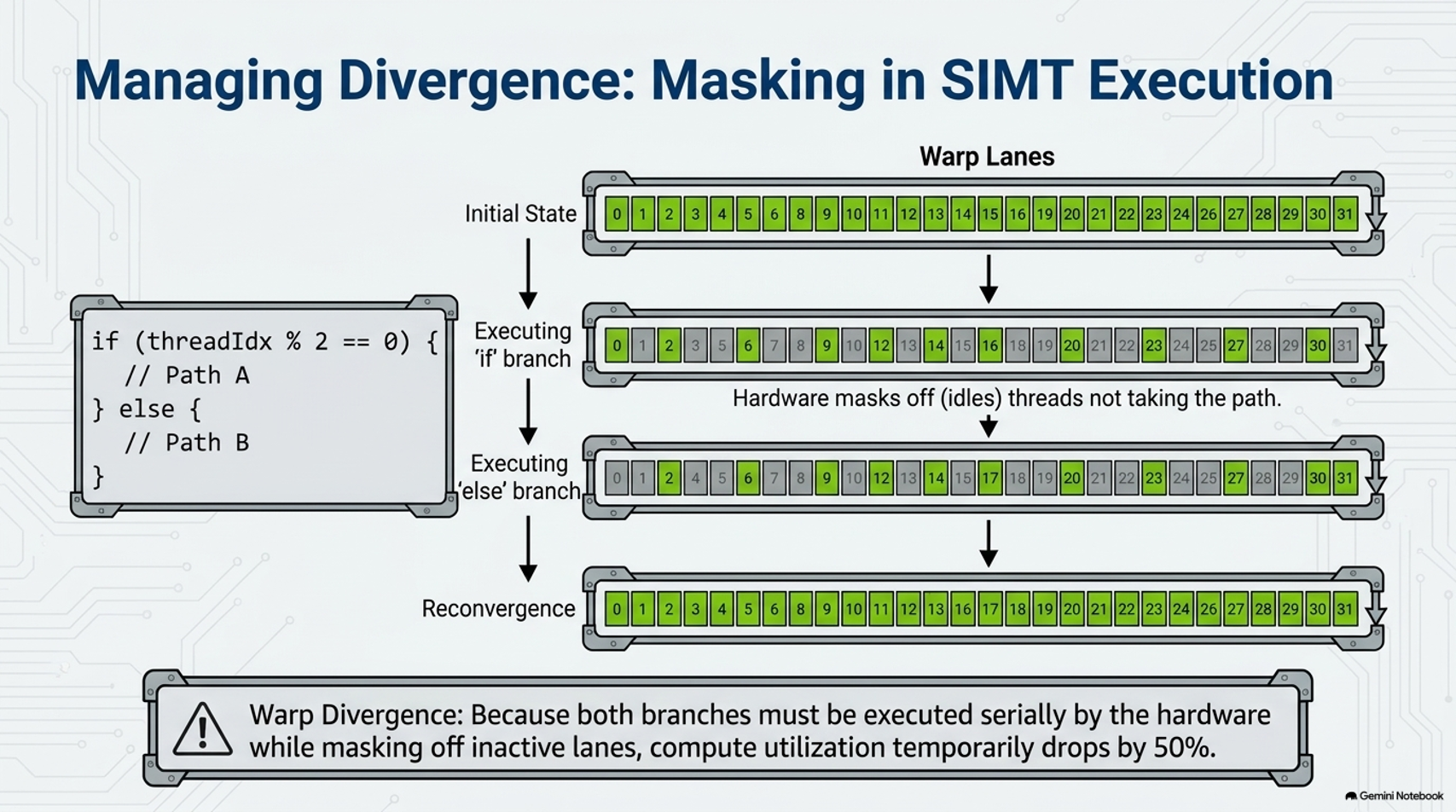
Warp: Wrap divergence
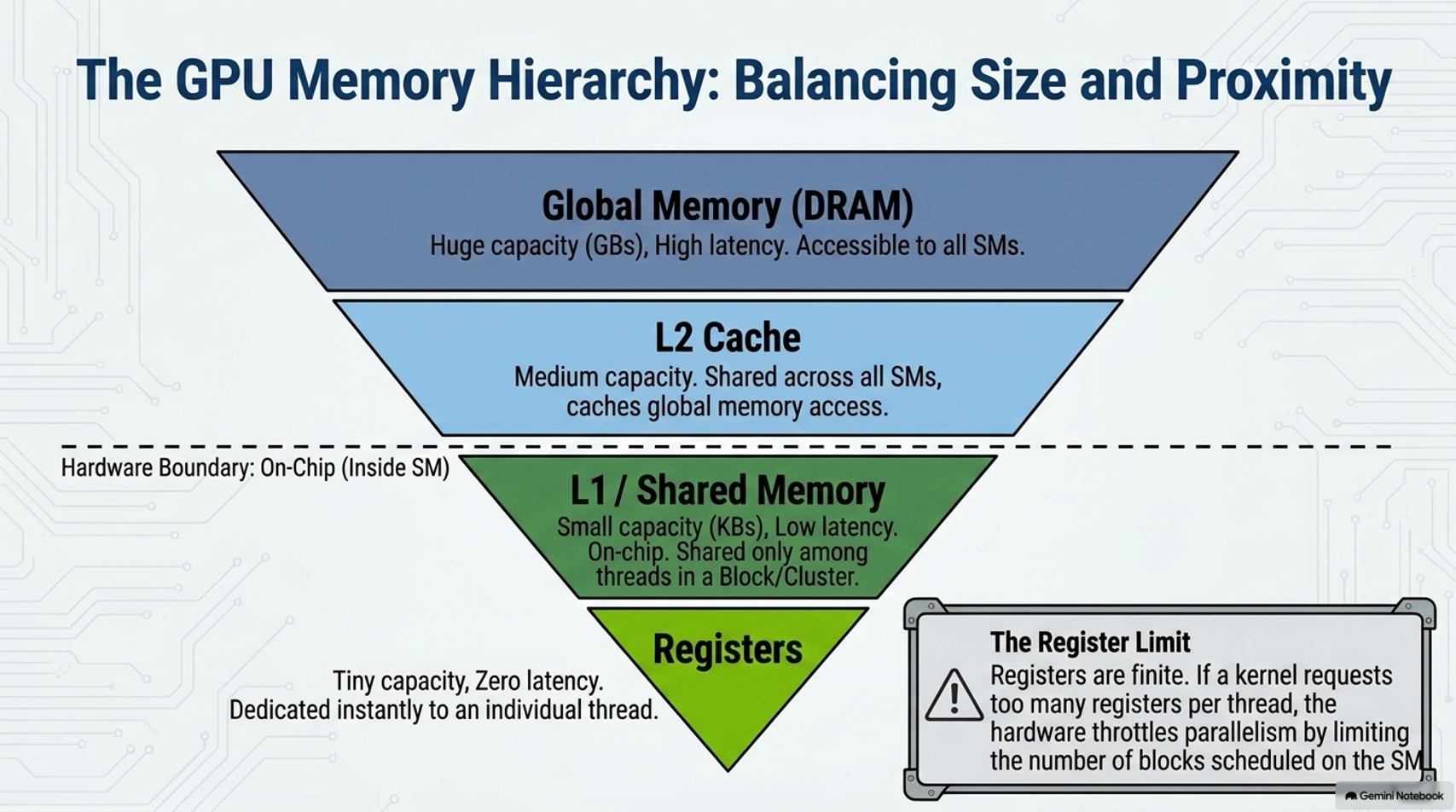
Memory: A note
Tensor Cores
Deep learning needs matrix multiplication
Most deep-learning compute reduces to GEMMs (\(C = AB\)). One output entry needs \(K\) multiply-adds: \(C_{ij} = \sum_k A_{ik} B_{kj}\).
Linear / attention
$C=AB$
tiles + warps
MMA
CUDA cores vs. Tensor Cores
CUDA core
- General-purpose scalar/vector arithmetic
- Flexible instructions
- One thread controls its own arithmetic
- Useful for arbitrary kernels
Tensor Core
- Specialized matrix-multiply-accumulate datapath
- Operates on small matrix tiles
- Designed for very high throughput
- Ideal for GEMM / convolution / attention
Think: scalar ALU vs. a tiny matrix-multiplication engine.
What does a Tensor Core actually compute?
Conceptually, an MMA computes \( D = A B + C \)
Inputs
Low/medium precision, e.g. FP16, BF16, TF32, FP8
Multiply
Many products computed in parallel
Accumulate
Into a wider accumulator, e.g. FP32
Tile shapes and supported datatypes depend on GPU architecture and instruction.
Tensor Core evolution
| Generation | Representative NVIDIA GPUs | Important capability |
|---|---|---|
| Volta | V100 | Tensor Cores introduced; FP16 → FP32 accumulation |
| Turing | T4 / RTX 20 | More formats + broader workloads |
| Ampere | A100 / RTX 30 | TF32, BF16, structured sparsity |
| Hopper | H100 | FP8, Transformer Engine, improved MMA |
| Blackwell | B100/B200/RTX 50 family | Further FP4/FP8-oriented AI throughput |
Why lower precision?
Lower precision means:
- More values moved per byte
- Smaller storage footprint
- More arithmetic units per area
- Higher matrix throughput
Typical ML pattern
FP16 / BF16 / FP8 inputs
↓
multiply at low precision
↓
accumulate in wider precision
From GEMM to Tensor Cores: tiling
Large GEMMs are decomposed into tiles; warps cooperate on tiles that map naturally to MMA instructions.
Warp-level matrix operations
A Tensor Core instruction is coordinated across threads in a warp.
Thread registers
Each lane owns fragments of matrices.
Warp
Threads collectively issue an MMA operation.
Tensor Core
Hardware consumes fragments and produces accumulator fragments.
- Fragment layout is architecture/instruction dependent.
- Higher-level APIs hide much of this complexity.
Tensor Cores and sparsity
Modern NVIDIA GPUs can accelerate certain structured sparse matrix operations.
Example: 2:4 sparsity
Within each group of four values, two are nonzero.
Dense:
$$[a,b,c,d]$$
Sparse 2:4:
$$[a,0,c,0]$$
Hardware/software encode the nonzero positions so the matrix engine can skip work.
Tensor Cores in Transformers
Linear layers
\( Y = XW \)
Usually excellent Tensor Core workloads.
Attention
\( QK^\top \) and \( PV \)
Matrix-heavy; shape and memory behavior matter.
MLP
Two large GEMMs dominate many transformer blocks.
This is why Tensor Core throughput is central to modern LLM training and inference.
References
- Mitzenmacher and Upfal. “Probability and Computing.” Chapters 3–4.
- NVIDIA. “CUDA Programming Guide.”